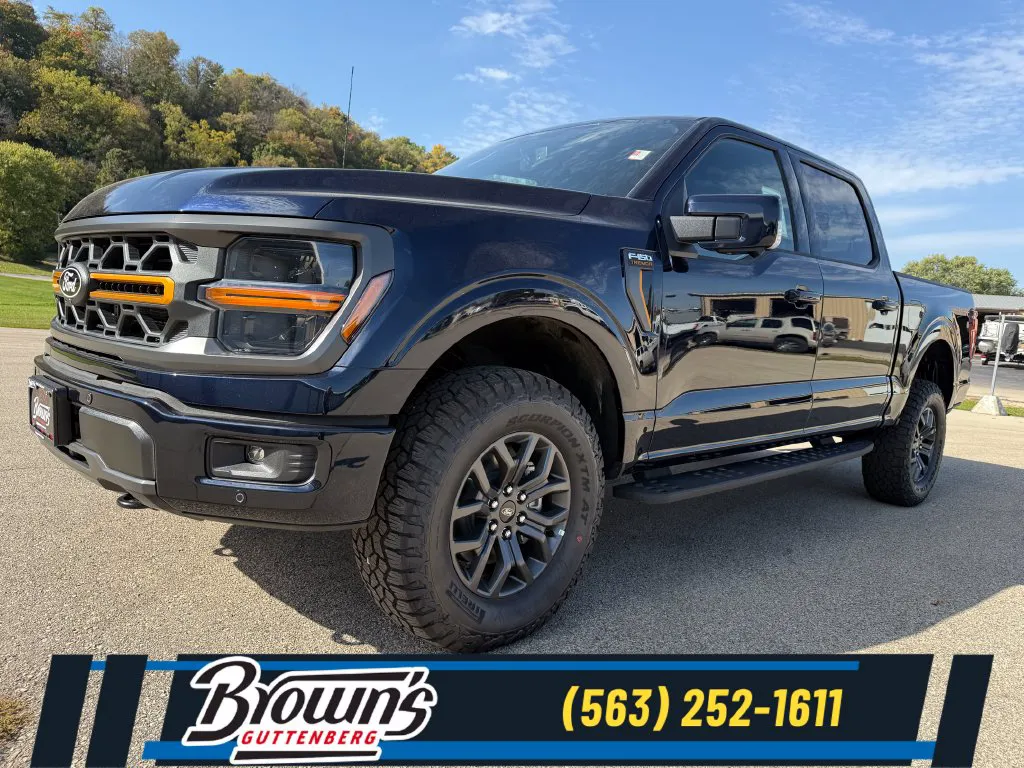
Shopping the 2026 Ford F-150 starts with more than a horsepower number. The 2026 Ford F-150 engine changes are easiest to understand when you compare the full powertrain lineup, the truck's intended work, and the configuration that supports it.
Explore Ford truck inventory to see which engines are listed right now.
Ford's 2026 F-150 technical specifications list turbocharged V6 engines, a naturally aspirated V8, a full-hybrid PowerBoost V6, and high-output choices for specialized performance. The right comparison depends on towing, payload, fuel, driving conditions, and the cab and bed you need. Brown's Guttenberg Ford, at 202 U.S. Hwy 52 S in Guttenberg, can match those specs to a truck that is actually here.
What the 2026 Ford F-150 engine changes actually are
Ford did not add a new displacement for 2026. The published horsepower and torque figures are the same family shoppers already know. What moved is where each engine is standard or newly offered. That is the change worth reading before you compare stickers.
Ford's own what's-new summary for the 2026 F-150 says the 3.5-liter EcoBoost V6 becomes standard on XL and XLT with the 157-inch wheelbase, on Lariat 4x2, and on Tremor. The 3.5-liter PowerBoost full hybrid is now available on STX equipment group 200A. In earlier model years, that hybrid started further up the trim walk.
Two related equipment notes sit next to those engines. On King Ranch and Platinum, 2.0 kW Pro Power Onboard is now a stand-alone option with the 3.5-liter EcoBoost. With PowerBoost on those series, 2.4 kW Pro Power Onboard is standard, and 7.2 kW is optional. Platinum groups 701A, 702A, and 703A include the 7.2 kW output. An STX hybrid does not automatically get that larger output. Ask which one, if any, is on the VIN.
Ford still lists six engine applications in the March 31, 2026 technical specifications, version 1.1.
- 2.7-liter EcoBoost V6 with 325 horsepower and 400 lb.-ft. of torque.
- 5.0-liter V8 with 400 horsepower and 410 lb.-ft. of torque.
- 3.5-liter EcoBoost V6 with 400 horsepower and 500 lb.-ft. of torque.
- 3.5-liter PowerBoost full-hybrid V6 with 430 combined horsepower and 570 lb.-ft. of torque.
- 3.5-liter EcoBoost high-output V6 with 450 horsepower and 510 lb.-ft. of torque.
- 5.2-liter supercharged V8 with 720 horsepower and 640 lb.-ft. of torque.
These ratings are useful for comparison, but they do not describe every truck. Ford notes that maximum horsepower, torque, payload, and towing are separate attributes. A truck may not achieve every maximum at the same time. PowerBoost figures combine the engine and the electric motor at peak battery power. The high-output EcoBoost and the supercharged V8 are rated on premium fuel.
2026 F-150 engine options at a glance
This table gives shoppers a starting point. The towing figures are available maximums from Ford's specifications. They require the right equipment and should not be treated as a promise for every truck with that engine.
| Engine | Power | Maximum conventional towing | Best comparison question |
|---|---|---|---|
| 2.7-liter EcoBoost V6 | 325 horsepower and 400 lb.-ft. of torque | Up to 8,400 pounds with 4x2 equipment | A smaller turbo for daily driving and moderate trailer work. |
| 5.0-liter V8 | 400 horsepower and 410 lb.-ft. of torque | Up to 12,800 pounds when properly equipped | A naturally aspirated V8 with strong conventional towing potential. |
| 3.5-liter EcoBoost V6 | 400 horsepower and 500 lb.-ft. of torque | Up to 13,500 pounds with qualifying 4x4 equipment | Frequent towing, where low-speed torque and the trailer rating matter. |
| 3.5-liter PowerBoost V6 | 430 combined horsepower and 570 lb.-ft. of torque | Up to 12,400 pounds with qualifying 4x2 equipment | Hybrid operation plus available onboard power for the workday. |
| 3.5-liter EcoBoost high-output V6 | 450 horsepower and 510 lb.-ft. of torque | Up to 8,200 pounds with qualifying 4x4 equipment | A performance truck, not a maximum-tow build. |
| 5.2-liter supercharged V8 | 720 horsepower and 640 lb.-ft. of torque | Up to 8,700 pounds with qualifying 4x4 equipment | High-performance response instead of everyday towing. |
Ford's official 2026 F-150 technical specifications include footnotes for equipment, fuel, configuration, and rating conditions. The availability notes are in Ford's 2026 F-150 what's-new summary. Read both before using any maximum as a buying target. A unit at Brown's can be sold or still in transit, and a transfer from another Brown's store is possible only if that truck is available.
Where the 3.5-liter EcoBoost became standard
Standard is the word that changes a payment and a test drive. On the series Ford names, a 2026 XL or long-wheelbase XLT, a Lariat 4x2, or a Tremor starts with the 3.5-liter EcoBoost unless the order says otherwise. That V6 is twin-turbocharged, makes 400 horsepower, and leads Ford's conventional tow chart when the truck is properly equipped.
The 2.7-liter EcoBoost is still in the lineup. It makes 325 horsepower and 400 lb.-ft. Ford lists a maximum conventional towing rating of 8,400 pounds with qualifying 4x2 equipment, and 8,200 pounds with 4x4. It also lists a 23-gallon fuel tank on the short 122.5-inch wheelbase, versus 36 gallons on longer trucks and on the 3.5-liter EcoBoost. For a commuter who rarely tows, the smaller engine can be the one to ask for.
For a farm load or a heavy trailer, do not assume the 2.7-liter is on the window sticker just because an older family F-150 had it. Tremor is the clearest 2026 example. Ford added Tremor equipment group 402B and made the 3.5-liter EcoBoost standard on that series. A lower sticker with the smaller engine is not the same truck.
The 2.7-liter EcoBoost uses regular 87-octane fuel in Ford's published table, as do the 5.0-liter, the standard 3.5-liter EcoBoost, and PowerBoost. Fuel grade is only one part of operating cost. Tire size, payload, trailer weight, and driving conditions matter too.
Why shoppers still compare the 5.0-liter V8
The 5.0-liter V8 offers a naturally aspirated alternative to the turbocharged engines. It is rated at 400 horsepower at 6,250 rpm and 410 lb.-ft. at 4,250 rpm. Its power delivery may appeal to shoppers who prefer a traditional V8 character and a simpler layout, without a turbo or a hybrid battery.
Ford lists maximum conventional towing of 12,800 pounds for the 5.0-liter engine. The table shows the same maximum for the listed 4x2 and 4x4 entries. Proper equipment remains essential, including the correct axle and trailer package. It is not the towing leader, and it is not the hybrid.
The V8 can be a strong fit for a buyer who wants that familiar engine and regular fuel. It is not automatically the best engine for every trailer. A 5.0-liter truck with one cab, bed, and package can have a different rating from another 5.0-liter truck. Ask to see the towing information for the exact vehicle, then compare the trailer's loaded weight, tongue weight, passengers, and cargo.
How PowerBoost on STX changes the shopping list
The 3.5-liter PowerBoost is a full-hybrid V6. Ford lists 430 combined horsepower and 570 lb.-ft. of torque. It pairs the twin-turbo 3.5-liter V6 with an electric motor and uses the 10-speed modular hybrid automatic, not the standard 10-speed SelectShift used with the gas engines. Fuel tank capacity is 30.6 gallons, smaller than the 36-gallon tank on the non-hybrid 3.5-liter.
The 2026 availability change is the shopping point. Ford says PowerBoost can now be ordered on STX 200A. A shopper who wanted the hybrid used to have to move up a series or skip it. For 2026, it is worth asking whether an STX on the ground, or one that can be located, actually has it. It is an available engine, not the only STX engine.
Ford lists up to 12,400 pounds of conventional towing with qualifying 4x2 equipment. The listed 4x4 maximum is 11,600 pounds. That is a useful reminder that the highest torque number does not automatically produce the highest towing number. The standard 3.5-liter EcoBoost still leads the tow chart, at 13,300 pounds for a qualifying 4x2 and 13,500 pounds for a qualifying 4x4.
Pro Power Onboard is the other reason to look at this engine. It can run tools or a camper away from a wall outlet, but only at the output fitted to that truck. King Ranch and Platinum also get 400-watt outlets in the cab and bed as standard equipment. Confirm the kilowatt rating on the build sheet.
Ford lists hybrid and electric unique components with 8-year/100,000-mile coverage in the same spec sheet. Read that as Ford's published warranty language for those parts, not as a promise that every hybrid on a lot still carries the full term. Coverage follows the warranty booklet and the in-service date. Batteries and hybrid hardware can also affect payload, so check the door-jamb label rather than a general maximum.
High-output engines are a different job
The 3.5-liter EcoBoost high-output V6 is rated at 450 horsepower and 510 lb.-ft. of torque. Ford lists a maximum conventional towing figure of 8,200 pounds in the 4x4 table. The 5.2-liter supercharged V8 is rated at 720 horsepower and 640 lb.-ft., with a listed tow figure of 8,700 pounds. Both require premium 91-octane fuel for their published ratings.
Those tow numbers sit well below a work-trim 3.5-liter EcoBoost. If the goal is a heavy equipment trailer, Raptor is the wrong chart. If the goal is off-road performance, say that when you ask about inventory so the search stays on the right trucks. Horsepower alone will not tell you which one to test.
How to compare a 2026 F-150 engine with the work
The engine with the highest horsepower is not automatically the best match. Use a short checklist before you compare a current Ford truck or ask about a specific unit.
- Write down your real trailer weight. Use the loaded weight, not an empty brochure weight. Include water, tools, cargo, and supplies.
- Estimate truck payload. Count passengers, hitch weight, tools, and cargo. Then compare that total with the exact truck's payload label.
- Choose the cab and bed first. A longer bed, a larger cab, and more equipment can change weight and available ratings.
- Decide how often you need four-wheel drive. Winter roads and farm lanes may point toward 4x4. The drivetrain can also change the published maximum.
- Compare the required package. Confirm the tow package, axle, hitch, and any Max Tow or Haul requirement.
- Review fuel guidance. Regular 87-octane is listed for the core engines. Premium 91-octane is listed for the high-output and supercharged engines.
- Separate daily driving from occasional maximums. A maximum tow rating may matter once a year. Ride, fuel use, and service access matter every week.
- Confirm current availability. A model-year specification does not mean that engine is on the lot. Ask about the exact truck before traveling.
Ford's footnotes connect certain maximums to cab, drivetrain, package, and axle. Two trucks with the same engine can carry different ratings. Keep the lowest limit in mind: trailer weight, payload, tongue weight, or hitch. The right result is the limit that fits the whole combination.
For Iowa farm work, access can matter as much as output. Think about gates, lanes, hills, and where you will turn a trailer around Guttenberg, Elkader, or Clayton County. Those names describe where shoppers live. They are not a delivery area, and Brown's does not promise timing or free transport for a truck located at another store.
What to confirm on a truck in Guttenberg
A model-year article can explain the choices. It cannot confirm a current unit. Inventory moves, vehicles can be sold, and incoming vehicles can change.
Start with new F-150s listed in Guttenberg or the broader remaining 2026 Ford inventory. A shopper comparing pre-owned trucks can review used trucks separately. A 2027 F-150 is a different model year. Do not mix its tow chart into a 2026 decision. The live 2027 F-150 engine lineup covers that year on its own.
When you find a possible match, ask for the VIN. Confirm the engine, whether it is standard or optional for that series, the cab, bed, axle, drivetrain, tow package, and payload label. If you are comparing a hybrid, ask which Pro Power Onboard output is included. You can call the store at (563) 252-1611 before you drive over.
A test drive is the right way to judge seating, visibility, and ride. Use the test-drive request page. A form is a request, not a confirmed appointment. The store confirms timing and which vehicle is available.
After the purchase, factory-trained technicians at the Guttenberg Ford service department can follow the oil-life monitor and the owner's manual for that engine. Motorcraft oil and a Motorcraft filter are the parts Ford recommends, and the grade and filter still have to match the engine. A 2.7-liter, a 5.0-liter, a 3.5-liter EcoBoost, and a PowerBoost are not interchangeable service jobs. A service request is not a booked appointment, and it does not include a promised loaner or same-day turnaround.
Prices, incentives, and payments stay off this comparison on purpose. A showroom figure is not a quote. Taxes, title, license, and registration can be extra. Incentives expire and can require qualification. Financing is an application, not an approval, a rate, or a payment.
Contact Brown's Guttenberg Ford and ask which 2026 F-150 engines are on the lot or available to locate.
Frequently asked questions
Did Ford add a new F-150 engine for 2026?
No. Ford's 2026 list keeps the 2.7-liter EcoBoost, the 5.0-liter V8, the 3.5-liter EcoBoost, and the 3.5-liter PowerBoost, plus the Raptor engines. The change is where each one is standard or newly available.
Which 2026 F-150 engine tows the most?
Ford's published maximum is 13,500 pounds for a properly equipped 3.5-liter EcoBoost V6 with qualifying 4x4 equipment, and 13,300 pounds for qualifying 4x2. The package, axle, cab, and bed matter. Confirm the exact truck before relying on the rating.
Is the PowerBoost hybrid available on a lower trim for 2026?
Yes. Ford says the 3.5-liter PowerBoost full hybrid is available on STX equipment group 200A for 2026. Confirm the build, because it is not the only STX engine.
Do all 2026 F-150 engines use the same fuel?
No. Ford lists regular 87-octane for the 2.7-liter, the 5.0-liter, the standard 3.5-liter EcoBoost, and PowerBoost. It lists premium 91-octane for the high-output EcoBoost and the supercharged V8. Confirm the fuel guidance for the exact vehicle.
Do these ratings guarantee a truck at Brown's?
No. They are Ford's published ratings. A truck at 202 U.S. Hwy 52 S may be sold or in transit. Ask Brown's Guttenberg Ford to confirm the engine and the current figures for a specific VIN.