

Choosing between two compact SUVs is easier when you start with the trips you make, the people and gear you carry, and the roads you use. In this Ford Bronco Sport vs Ford Escape guide, we’ll look at the differences that matter in daily life, from cargo access and passenger comfort to drivetrain choices and test-drive priorities. Features and specifications can vary by model year, trim and equipment, so compare the exact vehicles rather than relying on a nameplate alone.
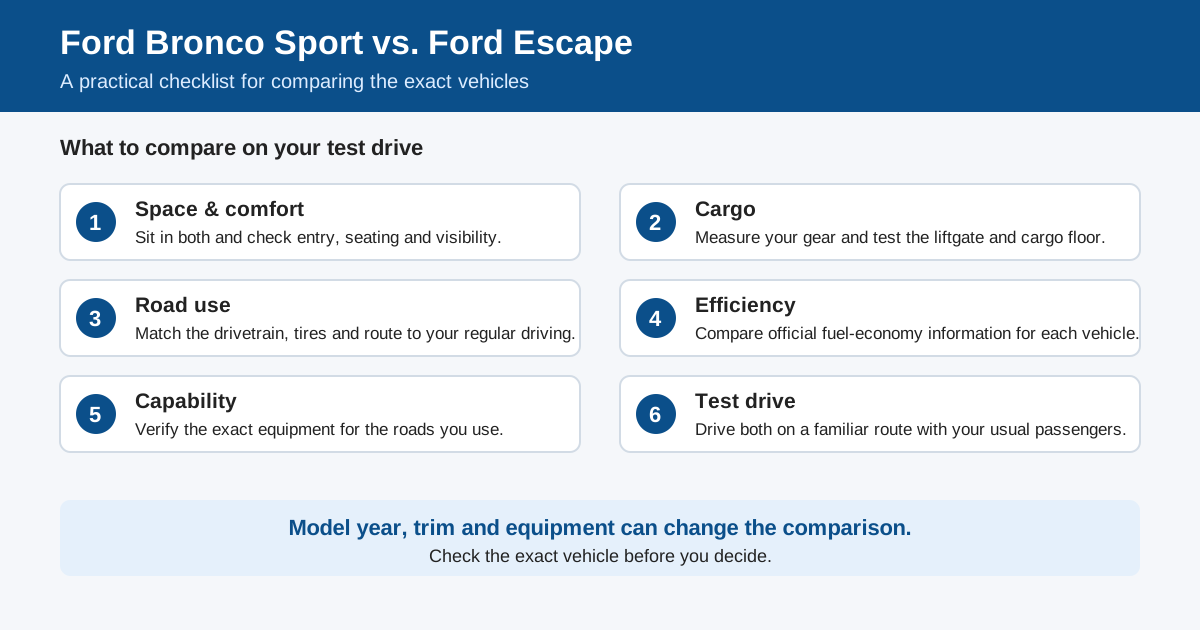
What is the main difference between the Bronco Sport and Escape?
The two Ford SUVs can serve many of the same basic needs: commuting, errands, carrying passengers and packing everyday cargo. Their overall character is different, though. The Bronco Sport has an upright, rugged design and an outdoors-oriented presentation. It tends to draw shoppers who like that look and want to evaluate a vehicle for mixed paved and unpaved travel. The Escape has a more conventional crossover shape and may appeal to drivers who are primarily thinking about a regular routine of work, school, shopping and highway trips.
That is a way to frame the comparison, not a claim that one vehicle is suitable for only one type of driver. An Escape owner may take a weekend trip, and a Bronco Sport owner may spend nearly every mile on paved roads. The useful question is which design, equipment and driving feel fit your own priorities. A model name by itself cannot tell you the exact engine, drivetrain, features, cargo layout or price of a particular vehicle.
It also helps to separate the decision into three levels. First, decide which overall shape and character you prefer. Second, identify the must-have equipment for your household and driving conditions. Third, compare specific model years, trims and vehicles that meet those needs. This keeps a broad impression from making the decision for you before you have checked the details.
How do the shapes affect everyday use?
Shape can affect more than appearance. An upright design may feel different when you sit in the cabin, look over the hood, load the rear and judge the vehicle’s corners while parking. A conventional crossover profile may feel more familiar to someone moving from a sedan or another everyday SUV. These are personal impressions, so the best comparison is to sit in both vehicles and repeat the same basic tasks.
Think about the places where you drive and park. If you use a short garage, a narrow driveway or a compact parking stall, check the dimensions for the exact model year and vehicle. Don’t rely on a general description such as “compact SUV.” Measure the available space, including room to walk around the vehicle, open the doors and raise the liftgate. If the vehicle will sit beneath shelving or a low garage door, height matters too.
Visibility also deserves a direct check. Adjust the seat and mirrors before deciding how easy it is to see beside and behind each SUV. Look at the view through the rear window, the angle of the hood and the places that disappear from view when you are backing up. Driver-assistance equipment may differ between vehicles or trims; verify what is actually included and learn how it works. Technology can help with awareness, but it does not replace careful driving.
- At the driver’s seat: Adjust the seat, steering wheel and mirrors. Notice whether you can find a comfortable position without straining.
- At the rear door: Check the opening, step-in height and how easily a passenger can get in and out.
- At the liftgate: Open and close it, inspect the opening and see how much room you need behind the vehicle to load.
- In a parking space: Check the view when turning in and backing out, and consider whether the vehicle feels manageable in your regular parking places.
How should you compare passenger space?
Passenger comfort is not captured by a single dimension. Seat shape, door opening, foot room, headroom, the position of the front seats and how many people travel together can all affect the experience. A driver who usually travels alone may care most about the front seat and view of the road. A household that regularly carries adults or children in the second row should spend more time checking rear access and comfort.
Bring the people who ride with you when practical. Ask each passenger to sit in the place they would normally use, rather than having everyone evaluate the SUV from the front seats. Check whether a rear passenger can sit comfortably behind the driver’s preferred seating position. If passengers often ride with bulky coats, backpacks or sports gear, see whether those items can be placed without crowding the seating area.
If you use a child safety seat, bring the seat along or bring the manufacturer’s dimensions and fit requirements. Try the installation in the position you expect to use. Check whether the front seat still adjusts comfortably, whether the child can be buckled without awkward reaching, and whether another passenger can use the remaining space. Fit can depend on the specific seat and vehicle, so a general statement about cabin size is not a substitute for checking your own setup.
For older relatives or anyone with limited mobility, pay attention to the height and angle of the seat, the width of the door opening and the distance from the ground to the seat. Have the passenger try getting in and out more than once. A vehicle that feels comfortable for a quick visit may feel different after a longer drive or repeated daily trips. Small comfort details often become important when they are part of every school run, appointment or commute.
Which SUV makes more sense for cargo?
Cargo capacity figures can be a useful starting point, but the shape of the space and the size of the opening may matter more than one published volume. A stroller, a dog crate, a cooler, farm or work supplies, sports equipment and luggage all occupy space in different ways. A wide but low item may fit one cargo area while a tall item may not. A vehicle’s rear-seat arrangement and cargo floor also affect how useful the space is for your particular load.
Make a short list of items you actually carry, including the largest item you expect to load in an ordinary month. Note its length, width and height. Then examine the cargo opening, the distance from the opening to the front seats and the shape of the wheel wells. If you often carry several bags at once, look at whether they can be arranged without blocking the driver’s view or interfering with passengers.
- Measure before visiting. Record the dimensions of awkward or essential items. Measure the item in the position you normally load it, not just its longest side.
- Inspect the hatch opening. Confirm that the item can pass through the opening and turn into the cargo area. Cargo volume does not guarantee that a particular object will fit through the hatch.
- Check the seat-folding process. Fold the rear seats and see how easy they are to operate. Look at the resulting floor, any slope or step, and whether the load space suits your gear.
- Test loading height. Imagine lifting a heavy box, cooler or tool case over the sill. If possible, bring a representative item and try it carefully.
- Repeat the same test. Compare both SUVs using the same items and seating arrangement, so you are not judging one with the seats up and the other with them folded.
The Bronco Sport’s utility-focused presentation may be one reason to consider it, while the Escape’s crossover layout may work well for household errands and mixed passenger-and-cargo use. Neither general description guarantees that your gear will fit. Confirm the actual opening and usable space in the vehicle you are evaluating, and consider how often you would need to fold the rear seats. If you carry passengers and cargo at the same time, test that real arrangement rather than judging maximum space alone.
Pay attention to how items can be secured. Loose cargo can move when a vehicle brakes or turns. Look for the tie-down points and storage areas on the specific vehicle, and make sure the things you carry can be placed safely. If you transport muddy boots, wet outdoor equipment or supplies that need separation from passengers, think through where those items would go and whether you need a container or protective liner. Verify available accessories and their fit for the model year rather than assuming all options are interchangeable.
What about all-wheel drive and rougher roads?
Drivetrain availability and equipment vary by year and configuration. If you often drive on gravel, snow-covered roads, steep driveways or unpaved access routes, check the drivetrain on the exact vehicle. Do not assume that every version of either SUV has the same setup. Ask which drivetrain is present, what tires are fitted and what the owner information says about the conditions for which the vehicle is intended.
The Bronco Sport’s outdoors-oriented design may be attractive if your trips sometimes include unpaved roads or outdoor destinations. That description is not a promise that every Bronco Sport is prepared for every trail, surface or weather condition. The Escape can be considered for daily driving in changing weather when appropriately equipped, but a crossover should not be treated as a dedicated off-road vehicle just because it has a particular drivetrain. Match the equipment to the road you will actually use, not to an imagined worst-case trip.
For a gravel lane, consider the condition of the surface, the clearance you need, the weather and whether you can turn around or pass another vehicle. For a rougher route, ask more detailed questions about the specific vehicle’s equipment and limits. A road that is muddy, deeply rutted or washed out can present challenges that are not solved by a model badge. Review owner guidance and use good judgment about whether the route is appropriate.
Winter driving also depends on more than the vehicle. Tires, speed, stopping distance, visibility and road conditions all play a role. Compare the tires on the particular SUVs and budget for the tire type that suits your conditions. If most trips are on maintained streets and highways, prioritize the regular commute and treat occasional rough-road capability as a secondary factor. Buying around a rare trip can mean compromising every day for a situation you seldom face.
How do efficiency and powertrain choices compare?
Fuel use and performance depend on the exact model year, engine, drivetrain, tires, equipment and driving pattern. Escape hybrid choices may be offered in some model years or configurations, but availability and specifications must be checked for the year and vehicle being considered. Do not assume that a powertrain available in one year is offered in another, or that two similarly named trims have identical equipment.
Ask for the official fuel-economy information that applies to each exact vehicle. Compare the figures on the same basis, and keep in mind that estimates are not a promise of what you will achieve. Stop-and-go traffic, cold weather, highway speed, hills, cargo, tire pressure and driving habits can all affect real-world fuel use. A hybrid may be worth evaluating if its specific configuration is available and your driving pattern suits it, but compare purchase details and equipment rather than assuming the label settles the question.
Think about your annual routine in practical terms. A long daily commute makes comfort and fuel costs more important than they may be for someone who drives short local trips. Someone who regularly travels between towns may care about how relaxed the cabin feels at highway speed. A driver whose week involves many short errands may pay more attention to maneuverability, seat entry and parking. These priorities help you decide what to test and which specifications to compare.
For performance, consider how the SUV responds in the situations you face: merging, passing where legal and safe, climbing a hill with passengers, or carrying the amount of cargo you usually bring. During a test drive, avoid making a judgment from one quick acceleration. Use an appropriate route and observe how the vehicle behaves at normal speeds. Ask about engine and drivetrain details from the vehicle information, then compare the actual configurations rather than broad assumptions about either model.
How do comfort and technology affect the choice?
Comfort is a collection of everyday details. Compare seat support, adjustment range, cabin noise, visibility, ride feel over familiar pavement and the placement of controls. A feature list can tell you whether equipment is present, but it cannot tell you whether a seat feels good to you or whether you find a screen easy to use. Spend time in each cabin before you decide.
Set up both vehicles in the same way. Adjust the seat and steering wheel, connect or pair your phone only if you are comfortable doing so, and locate the controls you expect to use often. Check the climate controls, audio controls, camera view and driver information displays. Do not let a feature that looks impressive during a demonstration distract from simple questions such as whether you can reach the controls without taking your attention from the road.
Technology and driver-assistance features can differ by model year, trim and package. If a particular feature matters, ask to see it on the exact vehicle and check the vehicle information. Learn whether it is standard or optional on that configuration and how it operates. Avoid assuming that a feature exists because you saw it on another vehicle of the same model. Confirm any limits and continue to drive attentively.
Ride comfort is also route-dependent. A smooth neighborhood street may not reveal how either SUV feels on the broken pavement, joints or hills you drive every week. If possible, use a route that includes a mix of low-speed streets and ordinary highway travel. Pay attention to how the suspension feels over uneven pavement, how much noise reaches the cabin and whether passengers can talk comfortably. Choose a safe, familiar route that reflects your use rather than seeking out a severe road just to test the vehicle.
Which SUV fits different kinds of routines?
A practical comparison becomes clearer when you describe a real week rather than an abstract buyer type. Consider these examples as prompts, not fixed recommendations. The best choice still depends on the exact vehicle and the person driving it.
A weekday commuter with occasional weekend trips
If your SUV is mainly for commuting, errands and paved highway trips, compare how each feels on your regular route. Notice the driving position, seat comfort, road noise, parking ease and the powertrain information. Ask whether you prefer the Bronco Sport’s upright, rugged character or the Escape’s more conventional crossover feel. If you only carry bulky outdoor gear a few times a year, decide how much weight that occasional use should have compared with comfort and convenience on every workday.
A household carrying passengers and equipment
If you routinely carry children, adults or sports equipment, assess passenger and cargo space together. Bring the child seat or measure the equipment, and check whether the cargo can fit while the seats are occupied. A vehicle that offers ample room with the rear seats folded may not match your usual family configuration. Give the people who ride in the second row a chance to evaluate entry, comfort and visibility. Repeated weekly use is a better guide than a one-time maximum-capacity test.
A driver who visits outdoor destinations
If weekends often involve trailheads, campgrounds, gravel access or outdoor gear, the Bronco Sport may deserve a close look because of its outdoors-oriented character. Still, describe the actual route and equipment needs before choosing. Is the access road maintained gravel, or do you encounter rougher conditions? Do you need room for a cooler, boots and bags, or simply a vehicle that feels comfortable on the highway to the destination? Confirm the drivetrain, tires and limitations of the exact vehicle. Do not assume the name means every version is appropriate for a demanding trail.
A driver focused on routine errands and easy use
If most of your driving is local, consider which vehicle is easier to live with in your actual parking spaces and daily stops. Test the liftgate, rear-seat access, visibility at intersections and maneuvering in a tight lot. A vehicle may be comfortable on a long drive but feel less convenient in a cramped parking area. Another may look straightforward in a brochure but have a seating or cargo detail that does not suit your household. A short, focused test is a better way to resolve these impressions.
A shopper weighing a used vehicle against a newer one
If you are comparing different years or a new SUV with a used one, separate the model comparison from the individual-vehicle comparison. A used Bronco Sport may have different equipment, condition, mileage and ownership history from a newer Escape. Compare the exact features you need, review the vehicle’s details and condition, and ask for VIN-specific warranty or program documents where relevant. A lower listed price or newer model year alone does not describe the complete value or cost of ownership.
What should you check on each specific vehicle?
Before visiting, make a short list of requirements and rank them. Mark each item as essential, preferred or optional. Essentials might include a particular drivetrain, a way to accommodate a child seat, a cargo opening that fits a necessary item, or a budget range. Preferences might include a certain cabin feel or convenience feature. Optional items are features you would enjoy but would not reject an otherwise suitable SUV for lacking.
Use the list to compare one vehicle at a time. Start with its model year and trim, then confirm engine, drivetrain, tires and included equipment. Check any packages or accessories that affect the features you care about. If the vehicle listing or window information does not answer a question, ask for clarification before treating the feature as included. A vehicle’s name and trim are not substitutes for reviewing the configuration.
- Model year and trim: Write both down. Specifications and available equipment can change from one model year to another.
- Powertrain and drivetrain: Confirm what is on the vehicle and compare it with your normal roads and driving habits.
- Interior configuration: Check the seats, cargo floor, storage and any features you expect to use often.
- Safety and convenience equipment: Verify the specific features on the vehicle information. Do not assume every version has the same equipment.
- Condition and history: For a used SUV, review the available condition and history information and ask about anything unclear.
- Price and availability: Prices are specific to the vehicle and date. Taxes, title, license, registration and financing may affect the total. Incentives can have conditions or expiration dates, and vehicles may be sold or in transit.
For a used SUV, ask what written information applies to the exact vehicle. If it is described as certified, confirm the program, eligibility, term and VIN-specific documents. “Certified” is not a single group-wide warranty. Likewise, do not assume that a used vehicle has a particular warranty based only on its age, mileage or model name. Read the applicable written terms before relying on a coverage description.
If you are considering a payment, use an estimate only as a planning tool. A calculator does not confirm financing approval, a rate or a promised payment. The total depends on the vehicle, taxes and fees, down payment, financing terms and other details. Ask for the specific figures and written terms that apply to your situation before making a decision. If trading a vehicle, compare the trade details separately from the SUV’s equipment and condition so you understand each part of the transaction.
How can you make a test drive useful?
A good test drive is a comparison exercise, not just a short spin around the block. Before setting out, identify what you want to learn. If you have two vehicles to drive, use a similar route and the same passengers or cargo in both, when practical. Otherwise, a change in route or conditions may shape your impression more than the difference between the SUVs.
- Begin with a stationary check. Adjust the seat, steering wheel and mirrors. Check the view in every direction, locate key controls and make sure the driver’s position feels natural.
- Use familiar streets. Include low-speed turns, stop-and-go driving and the kind of intersections you use regularly. Notice how easy it is to judge the vehicle’s size.
- Include a suitable faster road. If your normal routine includes highway travel, drive at an appropriate legal speed and listen for cabin noise. Notice whether you feel comfortable merging and maintaining your usual pace.
- Try parking and reversing. Use a safe, open area to check turning, backing and the available view. If equipped, examine the camera or assistance features without relying on them alone.
- Check passenger access. Have regular passengers get in and out, and ask them to evaluate the seat and available room.
- Recreate your cargo use. Fold the seats if needed and test the hatch opening with dimensions or a representative item. Return the seats to the arrangement you normally use.
- Record impressions immediately. Note what felt comfortable, what was awkward and what you still need to verify about equipment.
Try to make the route informative without forcing a risky or unusual test. You do not need to drive over severe bumps or attempt rough terrain to decide how the SUV feels in ordinary use. If a vehicle will be used on a particular kind of unpaved road, describe that route and ask whether the specific equipment is appropriate. Always follow owner guidance and drive within conditions and applicable rules.
After each drive, answer the same questions in writing: Was the seating position comfortable? Could you see clearly? Did the vehicle feel easy to park? Did passengers have the space they need? Could your largest items fit? Did the ride and cabin suit your route? Which features still need confirmation? Comparing written notes makes it easier to remember the first vehicle fairly after driving the second.
How should you compare ownership costs?
The sticker or advertised price is only one part of the cost question. Compare the price and equipment of the exact vehicles, then consider fuel, insurance, routine maintenance, tires and financing as separate items. Costs can vary with the model year, configuration, mileage, condition, coverage and your own driving. Avoid treating an estimate for one vehicle as a guaranteed cost for another.
For fuel, use the official information for the specific year and powertrain, then think about how many miles you drive and what those miles look like. City and highway estimates can help organize the comparison, but your result may differ. For maintenance and tires, ask what applies to the vehicle and consider its age, condition and use. A used SUV’s service needs cannot be judged from the model name alone; review its available records and ask questions about the individual vehicle.
Insurance is another reason to compare actual configurations. Request quotes using the vehicle identification information when possible, rather than assuming that two compact SUVs will cost the same to insure. For a used vehicle, include any inspection or immediate maintenance work you may want to complete. For financing, compare the full written terms and the total amount due, not just a monthly estimate. Optional protection products are not factory warranties; coverage depends on the agreement, vehicle, store and administrator.
A simple ownership worksheet can keep the discussion organized. Write down the exact year, trim and vehicle identification details for each candidate. Add the quoted vehicle price and any fees or taxes you have been given, then separately note your fuel estimate, insurance quote, expected maintenance considerations and financing terms. If a line is unknown, label it unknown instead of filling it with a guess. This makes the comparison more useful and highlights what to ask next.
Use a side-by-side decision guide
The following table is a starting point for your own notes, not a specification chart. It describes general character and questions to check. Verify equipment, capability, price and availability on each vehicle, because they can vary by model year and configuration.
| Decision point | Bronco Sport: consider if… | Escape: consider if… | What to verify |
|---|---|---|---|
| Overall feel | You prefer an upright, rugged, outdoors-oriented design. | You prefer a conventional crossover shape for everyday use. | Driver comfort, visibility and ease of entry. |
| Passenger routine | The actual seat layout and rear access suit your regular passengers. | The actual seat layout and rear access suit your regular passengers. | Try the seats with the people and child seats you use. |
| Cargo | You want to test a utility-focused layout with your own gear. | You want to test the cargo arrangement for commuting and errands. | Hatch opening, floor shape, seat folding and loading height. |
| Road conditions | You want to evaluate the specific equipment for your mix of paved and unpaved roads. | Your routine is mainly maintained roads and the configuration suits it. | Drivetrain, tires, owner guidance and route suitability. |
| Powertrain | The available engine and drivetrain match your needs. | The available engine and drivetrain, including any year-specific hybrid option, merit comparison. | Exact model year, trim, engine and official efficiency information. |
| Best next step | Drive it with your typical passengers or cargo. | Drive it on a familiar daily route. | Compare the same checklist and confirm the exact vehicle details. |
What if you are still undecided?
When both SUVs seem plausible, look for a deciding factor that appears in your routine more than once a year. It may be loading a child seat every morning, carrying tools every week, parking in a narrow garage each night or spending a long time on the highway several days a week. Give that repeated activity more weight than a feature you might use only occasionally. This does not make the occasional trip irrelevant; it simply helps put everyday needs in proportion.
Then ask whether your preference is based on a general impression or something you have confirmed. “I like the rugged style” is a valid preference, but it does not confirm cargo fit or capability. “I need room for this case” becomes a testable requirement once you measure it. “I want good efficiency” becomes a useful comparison when you identify the exact powertrain and consult the official information. Translate broad preferences into questions the vehicle can answer.
If one vehicle wins on one requirement and the other wins on another, decide which requirement is essential. For example, if the Bronco Sport appeals visually but the Escape gives you a more comfortable position on a long commute, think about how often each factor matters. If you prefer the Escape’s shape but need a certain cargo configuration, test that configuration before you rule out either option. There is no universal winner independent of the specific driver and vehicle.
You can also use a simple scorecard. Give each category a weight from one to three: essential, important or nice to have. Score each SUV from one to five based on your actual test, not on assumptions. Categories might include front-seat comfort, second-row fit, visibility, cargo usability, parking, road feel, required equipment and total cost. Add a note beside each score explaining what you observed. The notes are more valuable than the final number because they show what created the preference.
Where can you compare available vehicles?
Once you know which details matter, check the vehicles currently listed and confirm the exact model year, trim, equipment and availability. You can review new Bronco Sport SUVs and compare them with used Ford Escape listings. If you are also considering a used Bronco Sport or another Ford, check the used vehicle inventory and compare each vehicle on its own details.
Listings can change. A vehicle may be sold or in transit, and equipment, pricing and incentives are specific to the unit and date. If you have a particular configuration in mind, contact the store to confirm what is currently available and ask about the exact vehicle. If the right fit is not listed, the vehicle search request can help you describe what you are looking for; it is a request, not a promise that a specific vehicle will be found or secured.
For shoppers comparing a payment, the payment calculator can provide an estimate to help organize questions. It does not guarantee approval, a rate or a payment. Review the applicable written terms and all costs before deciding. If you want to discuss equipment, availability or a test drive, use the store’s contact page and identify the SUV you want to compare.
Which should you choose?
Consider the Bronco Sport if its upright style, outdoors-oriented character and actual layout suit your preferences, passengers, gear and roads. Consider the Escape if its conventional crossover feel, daily comfort and available powertrain choices better match your routine. Those are useful starting points, but the exact model year, trim and equipment can change the comparison. Test the features that matter instead of choosing from a broad label.
For a fair decision, identify your essential needs, compare the same details on both SUVs and drive them on a route that resembles your week. Bring a passenger, child seat or cargo item if it will help answer a real question. Confirm price, equipment, availability and any written terms for the specific vehicle before making a decision.
Compare available Bronco Sport SUVs
The better choice is the SUV that fits your regular life, not simply the one that looks best on paper, so verify the details and take the time to compare both in person.