There is no single best truck for farm use. A truck that hauls seed to the bin can be the wrong truck for a gooseneck of hay, a muddy lane, or a daily drive into town. The right choice is the configuration that matches the heaviest job you actually do, then still fits the miles you drive when the work is done.
Call Brown's Guttenberg Ford at (563) 252-1611
Start with the work, not the badge. Write down what you haul, what you tow, where you drive, and who else uses the truck. Then compare a specific cab, bed, axle, and tire package against that list. A published maximum is the ceiling for one build, not a promise for every truck on the lot.
What "Best Truck for Farm Use" Should Mean
Search results for this phrase usually name one favorite pickup. That answer skips the job. A compact truck can be the better daily tool. A heavy-duty truck can be the only honest choice for a trailer. Both can be wrong if the bed, the tires, or the axle do not match the work.
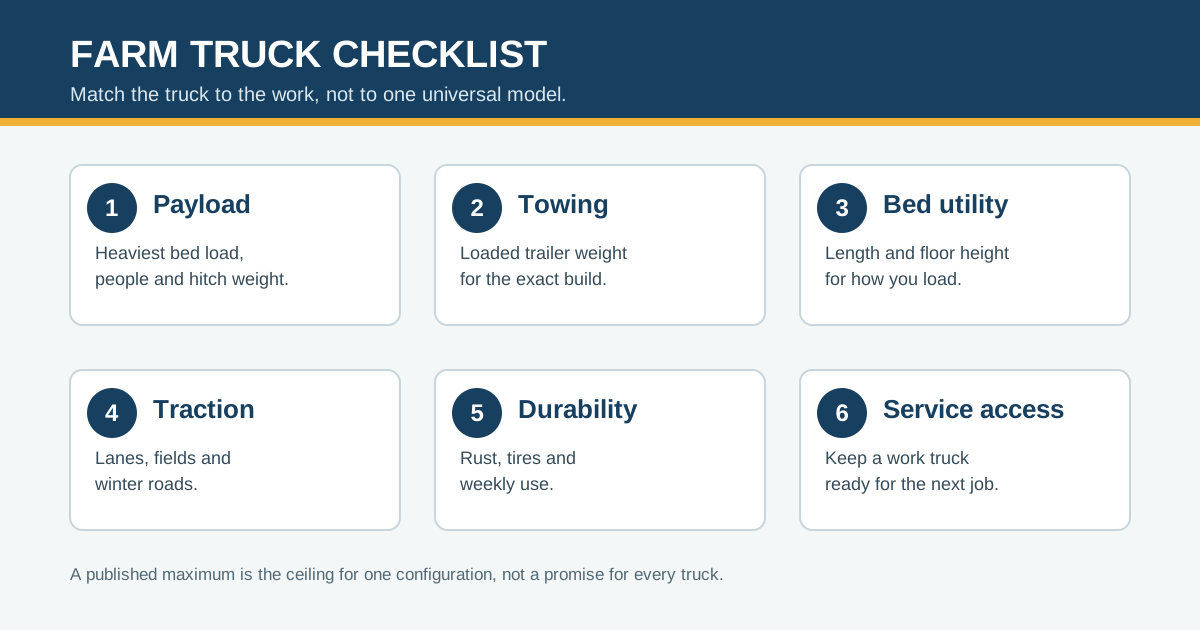
Use six checks, in this order:
- Payload for the heaviest load you put in the bed, including people and a trailer hitch.
- Towing for the heaviest trailer, using the rating for that exact build.
- Bed length and floor height for the cargo you load by hand or with a machine.
- Traction for the lanes, fields, and winter roads you drive.
- Durability for rust, tires, and the way the truck will be used every week.
- Service access, so a work truck is not sitting for a simple repair.
Iowa farm and agricultural households use trucks for all of those jobs. None of them requires a farm-only program, a special buyer, or one model. Brown's can help you compare a new Ford configuration at the Guttenberg new-truck inventory, or a used truck on the used-truck inventory. Stock changes, and a listed unit can sell.
Start With the Job, Not the Nameplate
Write the heaviest week, not the average week. A truck that is fine for most days can still be overloaded on the day that matters.
Cargo in the bed
List seed, feed, tools, a sprayer, a generator, or a pallet. Note the weight and whether it is a one-time load or a weekly load. People in the cab count against payload too.
Trailers
Separate a light utility trailer from a stock trailer, a gravity wagon, or a gooseneck. Write the loaded trailer weight, not the empty weight. Note whether you need a conventional hitch or a gooseneck.
Where it drives
A gravel lane, a wet field edge, and a salted winter highway ask for different tires and clearance. If the truck is also a family vehicle, say so. Comfort and cab space then matter as much as capacity.
Who uses it
If more than one driver will use the truck, pick a configuration each driver can handle. A long bed and a tall step-in are harder for some drivers than a shorter, lower truck.
Payload Is the First Limit
Payload is the weight the truck can carry in the cab and bed, including passengers, cargo, and the trailer tongue or pin weight. It is printed on the door-jamb label for that specific truck. Do not use a brochure maximum in place of that label.
Ford publishes best-case maximums, and they vary by cab, bed, engine, axle, and options. For 2026, Ford lists a best available gas payload of 2,440 pounds on F-150, up to 1,767 pounds on Ranger, and up to about 1,500 pounds on Maverick. Super Duty's published maximum available payload is 8,000 pounds. Those figures are ceilings for particular builds. A loaded crew cab with options can carry much less. Confirm the door sticker, and read Ford's notes on the F-150 page and the Super Duty towing page.
Tongue weight or pin weight counts against payload. A heavy conventional trailer can use 10 to 15 percent of its weight on the hitch. A gooseneck puts even more of the trailer weight on the truck. If the cargo plus the hitch weight exceeds the door-jamb payload, the truck is over its limit even when the trailer is under the tow rating.
For Guttenberg shoppers, compare a lighter daily truck such as Maverick or Ranger with a full-size F-150 before you step up. The smaller truck can be the better farm truck when the load is tools, bags, and a light trailer.
Match Towing to the Trailer You Own
Towing capacity is not one number for a model line. Ford's published maximums for 2026 are up to 4,000 pounds on Maverick, 7,500 pounds on Ranger, and 13,500 pounds of available gas towing on F-150. Super Duty's published maximum available towing is 40,000 pounds with the available high-capacity gooseneck package. A base truck without the tow package, the right axle, or the right hitch can be rated far lower.
Read the rating for the engine, cab, bed, axle ratio, and tow package together. Then compare it with the loaded trailer, not the dry trailer. Water, livestock, grain, and tools change the weight. Leave a margin. A rating that matches the trailer on paper leaves no room for a full tank, passengers, or a wet load.
Hitch type matters as much as the rating. A conventional receiver is enough for many utility and stock trailers. A gooseneck or fifth-wheel needs the bed prep, the hitch, and a truck rated for that connection. Super Duty is the lineup Ford builds for that heavier work. Look at F-250 and F-350 when the trailer, not the commute, is the main job. Availability at the store is not guaranteed.
Do not treat a payment calculator or a listed price as a quote. Taxes, title, license, and any incentive terms are separate, and incentives can expire or require qualification.
Bed Length and Floor Height Decide Daily Use
A higher tow rating does not help if the bed will not take the cargo. Measure the longest item you load and the way you load it.
Ford lists F-150 bed lengths of 5.5, 6.5, and 8.0 feet, with a bed width of 50.6 inches. An 8-foot bed fits many sheets and long tools that a short bed cannot. It also makes the truck longer to park and harder to see around. Ranger and Maverick use shorter beds. Maverick's cargo bed is about 4 feet 5 inches, with 42.6 inches between the wheel wells. That bed is useful for bags, tools, and small equipment. It is a poor fit for full sheets of plywood or long gates.
Floor height matters when you lift bags, a generator, or a cooler by hand. A compact or half-ton truck is usually easier to load than a heavy-duty 4x4 on tall tires. If you load with a tractor or a skid steer, floor height matters less and sidewall strength matters more.
Cab size trades against bed length. A regular cab with a long bed favors cargo. A crew cab favors people and a shorter bed. Decide which one you use more days of the year.
Traction for Lanes, Fields, and Winter Roads
Four-wheel drive helps on a farm lane, a field edge, and a snow-covered hill. It does not replace the right tires, and it does not increase payload or towing. Locking the front axle on dry pavement can hurt the driveline. Use it when a wheel is slipping, then unlock it on the road.
Match the tire to the surface. An all-terrain tire is a compromise for mixed gravel and pavement. A mud-terrain tire digs better and rides louder on the highway. Winter roads in northeast Iowa also need tread that still works when the lane is packed or icy. Ground clearance helps at a field entrance. Too much lift makes the truck harder to load and can change how a hitch sits.
Rear-wheel drive can be enough for a truck that stays on maintained roads and tows in good conditions. It is a weak choice if the truck must leave the gravel to reach a bin, a gate, or a calving pen. Write down the worst surface you drive, and shop the axle and tires for that surface.
A Farm Truck Checklist You Can Use on the Lot
Use this table while you stand next to a specific truck. The published Ford figures are 2026 maximums for particular builds. Your door-jamb label controls.
| Check. | What to confirm. | Where it usually fits. |
|---|---|---|
| Heaviest bed load. | Cargo plus people plus hitch weight, against the door sticker. | Maverick or Ranger for lighter loads. F-150 when the load grows. Super Duty when the sticker on a half-ton is not enough. |
| Heaviest trailer. | Loaded weight, hitch type, and the rating for that cab, axle, and package. | Maverick up to 4,000 pounds. Ranger up to 7,500. F-150 up to 13,500 gas, when equipped. Super Duty for gooseneck work up to the published 40,000-pound maximum. |
| Bed and cab. | Longest item, how you load it, and how many people ride. | Short beds for daily use. An 8-foot F-150 bed when the cargo is long. Super Duty when you need a gooseneck in the bed. |
| Traction. | Worst lane, field edge, or winter road, plus tire type. | Four-wheel drive and a tire matched to gravel, mud, or snow. Extra lift only if the entrance needs it. |
| Upkeep. | Where you will get oil, filters, tires, and a hitch checked. | A nearby service lane beats a higher rating you cannot maintain. Confirm the store can do the work. |
If two trucks pass the table, pick the one that is easier to live with on the other days. A farm truck still spends time on the highway, in town, and in a driveway.
Durability Is More Than a Tow Number
Farm use is hard on beds, hitches, and underbody parts. Look at how the truck is built for that use, then look at how you will maintain it.
A spray-in bed liner protects the floor from buckets, feed, and tools. Tie-downs and a proper hitch beat a loose strap. Mud flaps and underbody protection help on gravel. Wash salt and manure off the frame and wheel wells. Northeast Iowa winters put salt on the same roads that carry the truck to town.
Tires and brakes wear faster when the truck is loaded. Plan for that, and do not wait for a failure in the middle of a job. On a Ford, a sensible service choice is Motorcraft oil and a Motorcraft oil filter, confirmed to the engine in the owner's manual. Brown's Guttenberg Ford can order those parts through the parts center and can look at maintenance through the service center. A service form is a request, not a booked time. The store does not promise a loaner, a same-day finish, or a diagnostic price.
A used farm truck needs the same checklist, plus a closer look at rust, hitch wear, and service records. The used inventory is the place to start. Do not assume a "work truck" trim is tougher than the door sticker says. Trim names do not add payload.
How to Compare Trucks at Guttenberg
Bring the list. A useful visit covers one or two configurations, not every pickup on the lot.
Ask to see the door-jamb payload and the tow rating for that vehicle identification number. Ask which axle, tow package, and hitch are on the truck. Sit in the cab you would actually drive, and look at the bed length with the cargo you named. If you tow, ask whether the hitch and the wiring match your trailer.
You can schedule a test drive before you come, or contact the store at 202 U.S. Hwy 52 S in Guttenberg. A test drive is a request to drive a vehicle that is available. It is not a hold on that truck.
Financing, if you want it, is an application. It is not an approval, a rate, or a payment. The financing page explains how to apply. Any monthly figure from a calculator is an estimate.
Commercial chassis and cutaway models are a different shopping path from a pickup. If your work needs a chassis rather than a bed, say that up front. Do not use a pickup payload figure for a chassis cab.
Common Mistakes When Shopping a Farm Truck
Buying the highest tow number is the most common miss. You pay for capacity you may not use, and you live with a taller, longer, thirstier truck. Buying the nicest daily driver and hoping it will tow "once in a while" is the other miss. The trailer still has to fit the rating on that day.
Other misses are smaller and just as costly:
- Using a class maximum instead of the door sticker.
- Forgetting that hitch weight counts as payload.
- Picking a short bed, then finding the cargo does not fit.
- Choosing all-terrain looks over the tire you need for mud or snow.
- Ignoring where the truck will be serviced.
- Treating a listed price or a calculator result as the amount due.
A good choice is the smallest configuration that still covers the heaviest real job, with a bed and tires that match the week. That is the practical meaning of the best truck for farm use.
Frequently Asked Questions
Is there one best truck for farm use?
No. The best truck is the one whose payload, towing, bed, and traction match the heaviest work you do. A compact truck can be right for tools and a light trailer. A Super Duty can be right for a gooseneck. Naming one model for every farm skips that check.
Do I need four-wheel drive?
Get four-wheel drive if you leave maintained roads, climb a slick lane, or work through a northeast Iowa winter. You can skip it if the truck stays on cleared pavement and the trailer is within the rating. Tires still matter either way. Four-wheel drive does not raise payload.
How should I read a tow rating?
Use the rating for that cab, bed, engine, axle, and package. Compare it with the loaded trailer, and subtract hitch weight from the door-jamb payload. A published maximum, such as 13,500 pounds of available F-150 gas towing, applies only to the build Ford used for that figure.
Can a used truck be a better farm truck than a new one?
Yes, when the used truck's door sticker, hitch, and condition match the job and a new truck's extra capacity does not. Check rust, service records, and hitch wear. A used truck is not automatically tougher, and a work-truck trim does not add capacity.
Where can I compare these trucks near Guttenberg?
Brown's Guttenberg Ford lists new and used Ford trucks and can walk through a specific truck's label with you. Call (563) 252-1611 or use the contact page. Inventory moves, so confirm the truck is still available before you travel.
Bring the Checklist to the Store
Write the load, the trailer, the bed, and the worst road before you shop. Then match a real truck's door sticker to that list. Brown's Guttenberg Ford can show you what is on the lot and what a given Ford configuration is built to do.